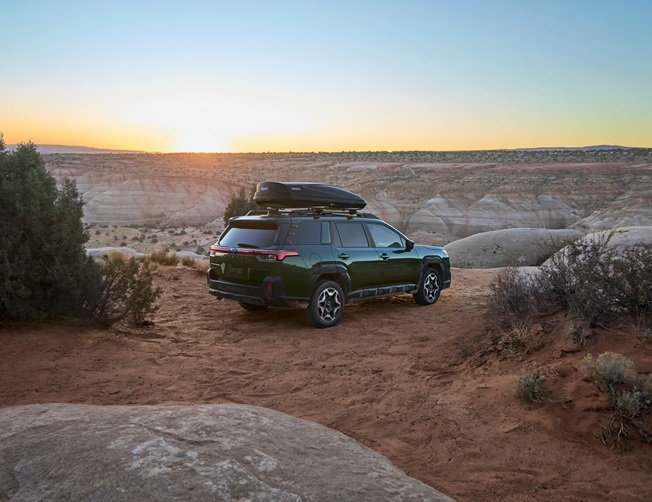
Subaru Outback vs Honda Passport
When two serious SUVs go head-to-head, the details matter. The Subaru Outback and Honda Passport are both capable, feature-forward vehicles built for drivers who want real performance without sacrificing daily comfort.
At Subaru of Wichita, we think the Outback makes a compelling case for itself across the board, and we're here to break down exactly why.
Outback vs Passport: Power, Torque, and Engines
The Honda Passport RT-L produces 285 horsepower from a 3.5-liter V-6 engine, while the standard Outback puts out 180 horsepower, and the Outback XT trims step it up to 260 horsepower via a turbocharged 2.4-liter BOXER engine. On paper, the Passport edges ahead in peak output, but numbers alone only tell part of the story.
The Outback's turbocharged XT engine delivers 277 lb-ft of torque starting at just 2,000 rpm, a broad, usable power band that kicks in early and stays strong across a wide range. That kind of torque availability means real-world responsiveness when merging, climbing grades, or towing.
The Passport produces 262 lb-ft of torque at 5,000 rpm, meaning you have to work the engine considerably harder to access its best pull. For everyday driving around Kansas highways, the Outback's low-end grunt gives drivers a more accessible and confidence-inspiring experience behind the wheel.
Both vehicles pair their engines with capable transmissions, but the Outback's Lineartronic CVT with 8-speed manual mode and steering wheel paddle shifters keeps drivers in control of every gear change, just the way they prefer it.
Outback vs Passport: All-Wheel Drive That Goes Beyond the Basics
Both the Outback and Passport come standard with all-wheel drive, which is great news for drivers in Kansas who deal with variable road conditions year-round.
The Outback's Symmetrical All-Wheel Drive with Active Torque Split continuously adjusts front-to-rear torque distribution using inputs from acceleration, steering angle, and yaw rate sensors, allowing it to proactively shift power before wheel slip even begins.
The Outback also features X-MODE, a driver-selectable system that optimizes engine output, CVT ratio position, and traction control logic specifically for challenging terrain. The Wilderness trim pushes this further with dual-function X-MODE, separate Snow/Dirt and Deep Snow/Mud settings, and Low Speed/Low Ratio Gradient Control for steep descents.
The Passport's i-VTM4 AWD system and seven-drive-mode selector (including Trail and Sand) are legitimate performers, but the Outback's Wilderness trim raises the bar with purpose-built off-road geometry and electronically controlled dampers that keep the suspension planted in terrain that would challenge most crossovers.
Outback vs Passport: Cargo, Interior Space, and Practical Dimensions
Practicality is where the Outback quietly separates itself. With rear seatbacks up, the Outback offers 34.6 cubic feet of cargo space, expanding to a substantial 80.5 cubic feet with the rear seats folded. That's genuine wagon-style versatility in a crossover body, built for camping gear, road trip luggage, or helping a friend move a piece of furniture.
The Outback's interior volume reaches 146.9 cubic feet total, with 43.0 inches of front legroom and 39.5 inches in the rear. Rear passengers get 57.4 inches of shoulder room, making longer drives comfortable for a full load of adults.
The Outback also runs on an 18-gallon fuel tank, giving XT drivers extended range between fill-ups, a practical win for anyone who covers long stretches of Kansas or heads out for longer drives regularly.
FAQs
Is the Subaru Outback good for off-road driving?
The Outback is well-suited for light-to-moderate off-road driving, and the Wilderness trim takes things further. With 9.5 inches of ground clearance, all-terrain tires, electronically controlled dampers, and dual-function X-MODE with a Low Speed/Low Ratio Gradient Control system, the Wilderness is one of the most off-road-capable vehicles in its class.
Standard Outback trims handle unpaved roads, gravel, and wet terrain with ease thanks to Symmetrical AWD and X-MODE's Snow/Dirt and Deep Snow/Mud settings.
How does the Subaru Outback's fuel economy compare to the Honda Passport?
The Outback's EPA-estimated fuel economy figures for the 2026 model year are to be determined, so we recommend checking directly with our dealership or the official EPA database for the most current ratings.
The Outback's standard 2.5-liter engine is a naturally efficient BOXER four-cylinder with direct fuel injection. The Honda Passport's V-6 comes with Variable Cylinder Management that deactivates cylinders under light loads to conserve fuel, so both vehicles prioritize efficiency in their own ways.
What safety technology does the Subaru Outback include?
The Outback comes equipped with Subaru's EyeSight Driver Assist Technology, which includes a suite of active safety features. Drivers also get:*
- Vehicle Dynamics Control with electronic traction control
- Active Torque Vectoring
- Auto Vehicle Hold
- Incline Start Assist
- Hill Descent Control
For a full breakdown of available safety tech by trim, our team is happy to walk you through every detail.
Test Drive a Subaru Outback Today!
The Subaru Outback brings a lot to the table, and comparing it against competitors like the Honda Passport only makes the case clearer. Whether your priorities are all-weather traction, interior practicality, or trail-ready performance, the Outback has a trim built specifically for how you drive.
Subaru of Wichita is ready to answer your questions, help you explore available inventory, and get you behind the wheel of the right vehicle. Reach out today!
*Source: Subaru